Knowledge Center
This Gold Phoenix PCB Knowledge Center article explains adhesives in flexible and rigid-flex PCB construction, including adhesive types, prepreg bonding, and IPC guidelines.
In a flex or rigid-flex PCB construction, many elements are important to the overall design, such as copper weight, layer count, and many others. However, among all the portions of a design, one that is often overlooked is what bonds and holds it all together: the adhesives and prepregs that bond the stack-up.
In flexible PCB stack-ups, adhesives play a core role, and only rare instances of a stack-up contain no adhesives. In rigid-flex designs, adhesives are used in the flexible portions, while prepregs are used to bond the rigid portions and keep the layers together.
In flexible circuits, adhesives are one of the most critical parts of a stack-up. While some stack-ups can exist without adhesives, it would be difficult to operate without them. From the coverlay to the stiffeners, extra pressure-sensitive adhesives applied to the exterior of the circuit board, and even adhesive-based cores, adhesives play a major role in forming the stack-up of a flexible circuit.
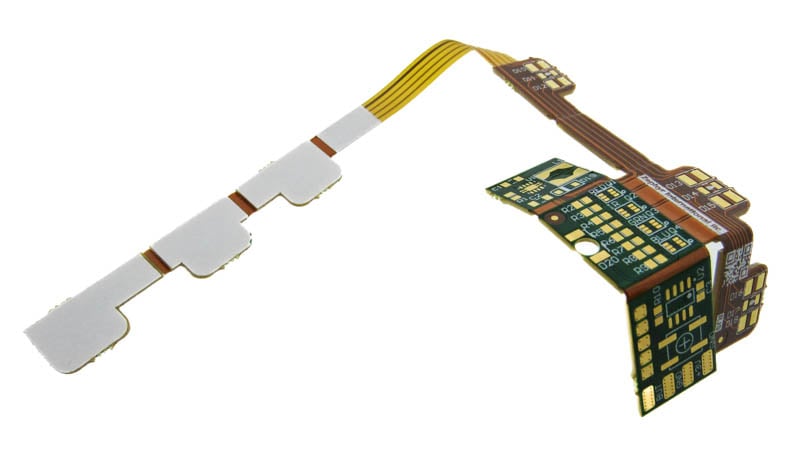
Rigid-flex PCB with pressure sensitive adhesive.
When it comes to adhesives for a flexible circuit, they usually come in three different varieties.
The first are acrylic adhesives. These are versatile adhesives and have proven to be among the most commonly used adhesives in many offshore manufacturing locations.
Next are epoxy adhesives. These are less commonly seen than acrylic; however, they serve a purpose because they can be less reactive to some chemical environments than acrylic. The downside is that, due to the nature of epoxy adhesives, they can sometimes be regarded as slightly stiffer than acrylic adhesives, and the lower demand can mean increases in cost or lead times depending on the materials used.
The last of the three adhesives are polyimide-based adhesives. These can withstand higher temperatures than the previous two, and they are highly chemically resistant. The downside is that demand is so low for this adhesive that many PCB manufacturers cannot support it. Aside from low demand, the process to manufacture it requires specialty lamination procedures that go beyond what many circuit board fabrication shops can perform.
In rigid-flex circuits, the role of normal adhesives remains the same because of the flexible portion of the part. However, this changes when considering the rigid section, where adhesives are recommended to be removed. This recommendation comes from IPC guidelines, suggesting that, due to the differing coefficients of thermal expansion of the rigid and flexible materials, it is best to make sure no adhesives extend into the rigid section where a through-hole would travel through it.
This can be quite a limiting factor, leading to innovations that allow multi-layer flexible sections within rigid-flex PCB designs to be bonded in some sections with adhesives, whereas in the rigid portions of the stack-up, they are bonded with a near-equivalent thickness of prepreg. This provides a way to avoid including adhesives in rigid stack-ups and results in a more reliable build.
As for what prepregs are used, the main restriction is that prepregs must be what is referred to as “no-flow” or, depending on the manufacturer definition, sometimes referred to as “low-flow.” These terms refer to the propensity of the prepreg to flow during lamination processes. In a rigid-flex PCB stack-up, it is most desirable for the prepreg to exhibit little to almost no flow characteristics, so that it does not flow out into the flexible section and interfere with its bending capability. These types of prepregs are achieved by taking the standard formulation and changing it with the addition of a polymer and, in some cases, by inducing a form of pre-lamination with the manufacturer that can dramatically reduce the flow characteristics of the selected prepreg.
Bonding within rigid-flex PCBs and flexible circuit board applications can be quite a complicated process. While the terminology can be unexpected and the different adhesives can be difficult to remember, it is always important to consider the application the part is meant for and the environment it is set to be in.
This is the single most important factor and can heavily influence the material choice when designing the circuit board. While this can sound like a daunting task, involving the circuit board manufacturer from the start can greatly help in deciding how to approach the stack-up for a design, what materials should be used, and which materials can be supported.
Capabilities
Payment Methods


Specials Price
Carriers


Support Hobbyist
Certificate


Customer Support
Follow Us