Knowledge Center
This Gold Phoenix PCB Knowledge Center article explains the difference between countersink and counterbore hole preparations in PCB fabrication, and the specifications required to produce each correctly.
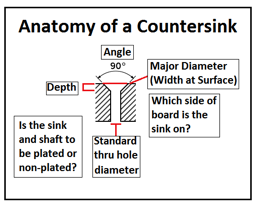
A countersink is a cone shaped hole cut into the laminate. It is typically used to allow the tapered head of a screw to sit flush with the top of the laminate. By comparison, a counterbore makes a flat-bottomed hole and its sides are drilled straight down. This is usually used to fit a hex-headed cap or screw. To accurately drill countersunk holes, the following information is required.
1. Angle of the drill
2. Major Diameter (finished diameter of the hole at the surface)
3. Depth the countersink is to be drilled
4. On which side of the board is the sink? Top or Bottom?
5. The finished diameter of the shaft of the hole
6. Is the sink and shaft to be plated or non‑plated?
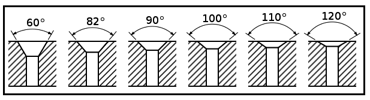
Countersink examples at different angles.
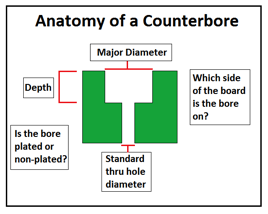
A counterbored hole is typically used when a fastener such as a bolt or cap head screw is required to sit flush with or below the level of a surface. To fabricate counterbored holes, the following information is required.
1. Major Diameter (finished diameter of the hole at the surface)
2. Counterbore depth
3. On which side of the board is the sink? Top or Bottom?
4. The finished diameter of the shaft of the hole
5. Is the bore and shaft to be plated or non‑plated?
Because the sides of the hole are always parallel, there is no need to specify an angle.
Capabilities
Payment Methods


Specials Price
Carriers


Support Hobbyist
Certificate


Customer Support
Follow Us