Knowledge Center
This Gold Phoenix PCB Knowledge Center article introduces and compares common PCB surface finishes and their key selection considerations.
When ordering printed circuit boards (PCBs), you should consider items including PCB substrate material, solder mask, silkscreen, surface finish, board size and thickness, copper thickness, blind and buried vias, through-hole plating, SMT, panels, tolerances, etc. prior to the actual fabrication of your circuit boards. Among those items, the selection of surface finish belongs to the first class as surface finish plays an extremely significant role in contributing to the reliability of electronic products. As the copper layer on PCBs can be easily oxidized, the generated copper oxidation layer will seriously reduce soldering quality, which will decrease the reliability and validity of the end products. Surface finish is conductive to preventing pads from oxidation and guaranteeing excellent solderability and electrical performance.
Surface finish, or surface coating, is the most important step in the process between PCB manufacturing and PCB assembly with two main functions, one of which is to preserve the exposed copper circuitry and the other of which is to provide a solderable surface when soldering components to the PCB. Surface finish is located at the outermost layer of the PCB and above the copper, playing a role as a “coat” for the copper.
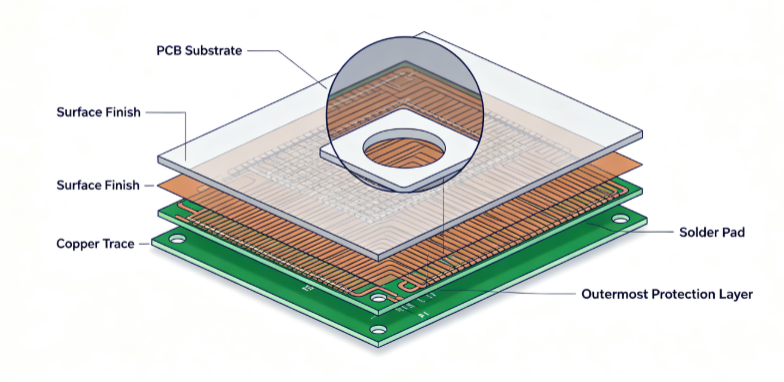
Basically, there are two main types of surface finishes: metallic and organic. HASL, ENIG, ENEPIG, Immersion Gold, and Immersion Tin all belong to metallic surface finishes while OSP and Carbon Ink belong to organic surface finishes.
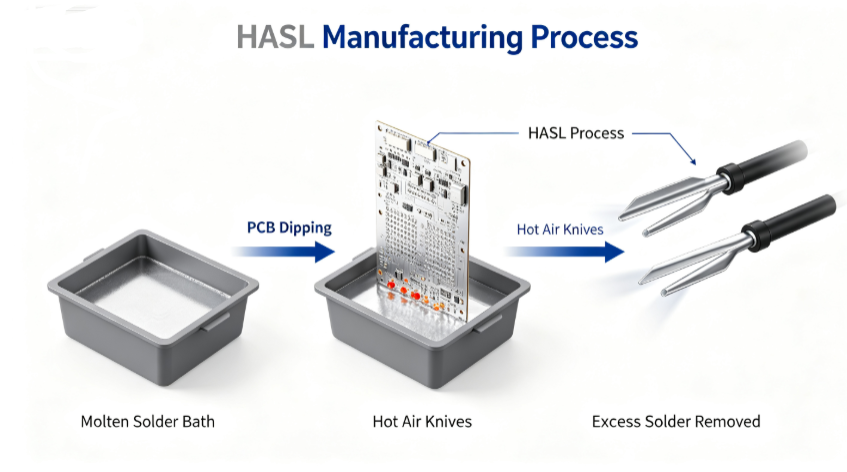
HASL is a conventional type of surface finish applied on PCBs. The PCB is typically dipped into a bath of molten solder so that all exposed copper surfaces are covered by solder. Extra solder is removed by passing the PCB between hot air knives.
Pros of HASL Surface Finish:
Excellent wetting during component soldering
Copper corrosion avoided
Cons of HASL Surface Finish:
Low planarity on vertical levelers makes HASL unacceptable for fine pitch components
High thermal stress during the process can cause defects in the circuit board
In order to conform to regulations concerning environmental protection, HASL develops into two subcategories: lead HASL and lead-free HASL. The latter caters to the regulations and laws of RoHS (Restriction of Hazardous Substances) first adopted by the EU.
ENIG, short for Electroless Nickel Immersion Gold, consists of electroless nickel plating covered with a thin layer of immersion gold, which protects the nickel from oxidation. ENEPIG, also known as Electroless Nickel Electroless Palladium Immersion Gold, differs from ENIG in that a layer of palladium is applied as a resistance layer to stop nickel from oxidation and diffusion to the copper layer. Compared to other types of surface finishes, ENIG and ENEPIG provide the highest solderability for PCBs but the cost is much higher.
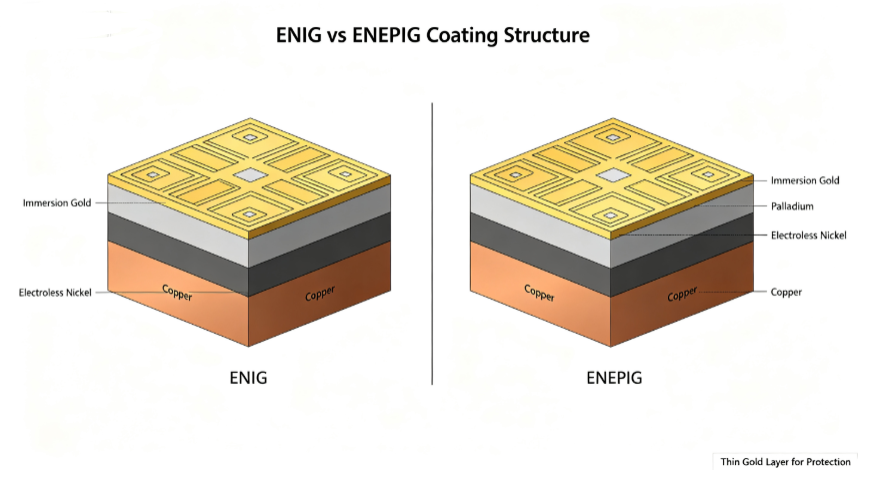
The electroless nickel step is an auto-catalytic process that involves depositing nickel on the palladium-catalyzed copper surface. The reducing agent containing nickel ions must be replenished in order to provide the proper concentration, temperature, and acid degrees necessary to create a consistent coating. During the immersion gold step, the gold adheres to the nickel-plated areas through molecular exchange, which will protect the nickel until the soldering process. The gold thickness needs to meet certain tolerances to ensure that the nickel maintains its solderability.
ENIG and ENEPIG have their own pros and cons respectively. For example, ENIG features a flat surface, simple process mechanism, and high temperature resistance while ENEPIG is capable of withstanding excellent multiple reflow cycles and features highly reliable wire bonding capability. Based on the comparison between ENIG and ENEPIG, they can be applied in different applications for different purposes. ENIG is suitable for lead-free soldering, SMT (Surface Mount Technology), BGA (Ball Grid Array) package, etc. while ENEPIG is capable of meeting strict requirements of multiple types of packages including THT (Through-Hole Technology), SMT, BGA, wire bonding, press fit, etc.
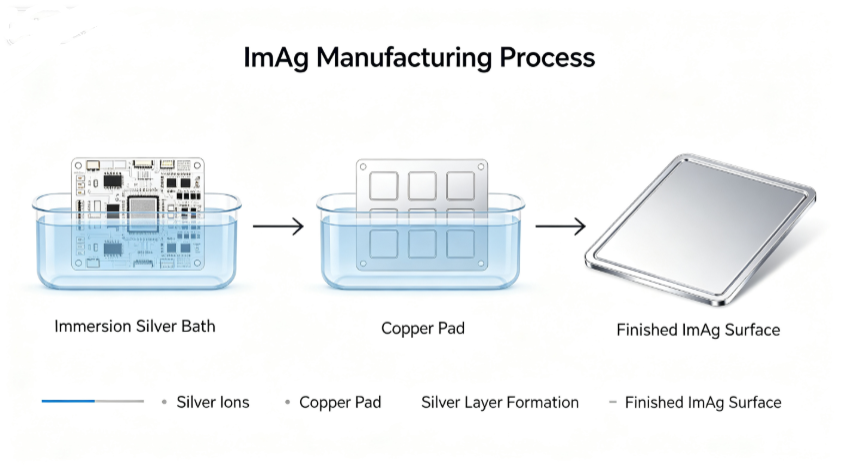
ImAg consists of thin immersion silver plating over the copper traces.
Pros of ImAg Surface Finish:
Planar surface
Short, easy process cycle
Inexpensive
High conductivity
Good for fine pitch products
Copper/Tin solder joint
Reworkable
Does not affect hole size
Cons of ImAg Surface Finish:
Tarnish
Silver migration
Planar micro voids
Creep corrosion
ImAg is a good type of surface finish for soldering and testing. Creep corrosion is its major weakness.
ImSn is mostly the same as ImAg except that tin is used in ImSn while silver is used in ImAg. In terms of the advantages of ImSn, it provides an extremely planar finish on the copper pads, making it very suitable for SMT applications. Besides, ImSn provides a surface that is easily detectable by common Automated Optical Inspection techniques.
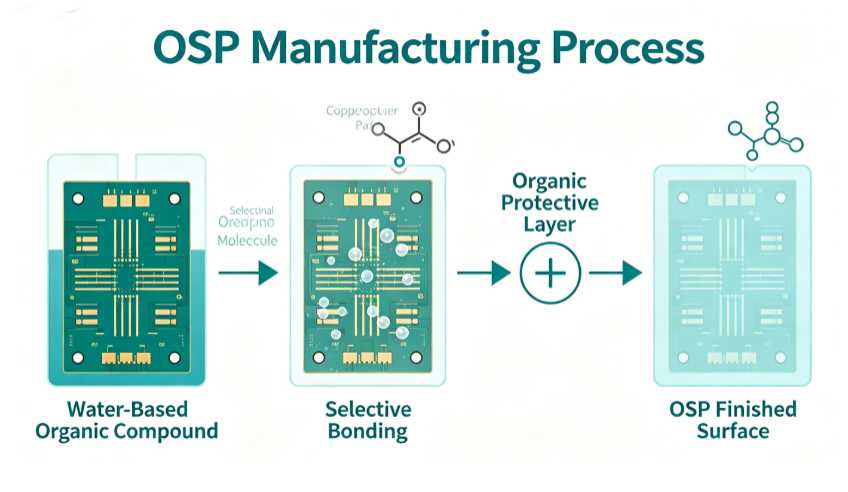
OSP is a type of surface finish with transparent organic material applied. It uses a water-based organic compound that selectively bonds to copper and protects the copper until soldering.
Pros of OSP Surface Finish:
Flat/planar
Short, easy process cycle
Inexpensive
Reworkable
Does not affect finished hole size
Copper/Tin solder joint
Cons of OSP Surface Finish:
Multiple reflows
Limited shelf life
Not conductive
Difficult to inspect
Limited thermal cycles
In summary, each type has its own advantages and disadvantages. You should select the best-fit surface finish according to your electronic product’s utilization purposes, performance requirements, cost, corrosion resistance, ICT (In-Circuit Test), hole fill, etc. The more items taken into consideration during the selection, the more accurate your conclusion will be.
Comparing these types of surface finishes, generally speaking:
Cost: ImAg and OSP are the most inexpensive while ENIG is the most costly.
Corrosion Resistance: HASL and ImSn have the best corrosion resistance capability while ImAg has the worst.
ICT: Only OSP is the worst while others are similarly good.
Hole Fill: HASL and ENIG are better than the other types.
Surface finish selection on PCBs is the most important step for PCB fabrication since it directly influences process yields, rework numbers, field failure rate, test capability, scrap rate, and cost. All the important considerations about assembly must be taken into surface finish selection in order to ensure the high quality and performance of end products.
In the PCB assembly process, people with different positions have different opinions on how to select surface finish.
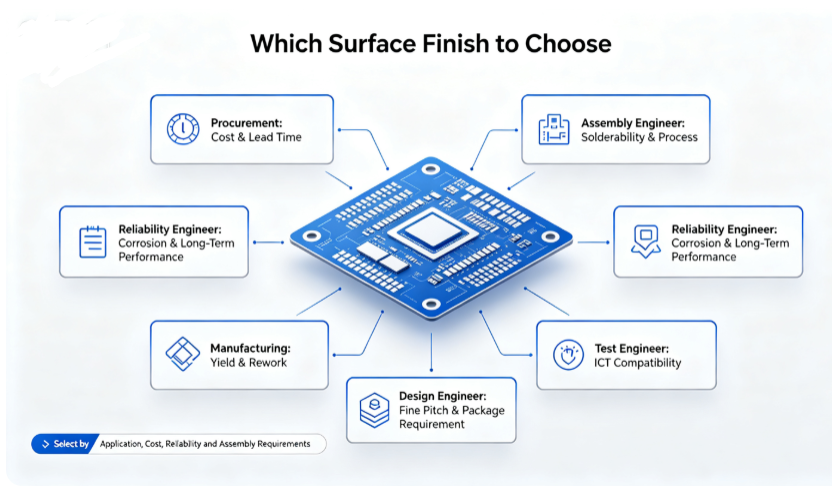
Apparently, people with different positions have different selection standards. No matter what type is selected, it only caters to the requirements and convenience of people with few considerations about the quality, performance, and reliability of PCBs and PCB assembly.
Based on the introduction of each type of surface finish above, some attributes are the most important elements as the selection standard. The table below shows the attributes each type of surface finish HAS and DOES NOT HAVE. Based on specific requirements and features of PCB products, you can follow this table to select the perfect surface finish option.
| Items | HASL | ENIG | ENEPIG | ImAg | ImSn | OSP |
|---|---|---|---|---|---|---|
| Cost sensitive product | ✓ | ✗ | ✗ | ✓ | ✓ | ✓ |
| High volume required | ✗ | ✗ | ✗ | ✓ | ✓ | ✓ |
| Cosmetics of surface finish | ✓ | ✗ | ✓ | ✗ | ✓ | ✓ |
| Lead-free wave solder | ✓ | ✓ | ✓ | ✓ | ✗ | ✗ |
| Fine pitch components used | ✗ | ✓ | ✓ | ✓ | ✓ | ✓ |
| High yield ICT | ✓ | ✓ | ✓ | ✓ | ✓ | ✗ |
| Lead-free shock/drop | ✓ | ✗ | ✗ | ✓ | ✓ | ✓ |
| Possibilities of corrosion failure | ✓ | ✓ | ✓ | ✗ | ✓ | ✓ |
As for the type of surface finish selection, an optimal type must be selected and numerous functions can be accomplished. Each type of surface finish has its own advantages and disadvantages. There are some engineering tricks as solutions to the problems caused by the disadvantages of surface finishes. For example, as for the disadvantage that OSP has lower wetting force, some solutions are available such as changing board solderability plating or wave solder alloy, increasing top-side preheat, etc. The key point is that all possible elements must be considered in order to obtain ideal performance.
Nowadays, environmental issues have become increasingly important in the electronic fields. In order to restrain the generated hazardous substances, RoHS is published by the EU. RoHS, also known as Lead-Free, stands for Restriction of Hazardous Substances. RoHS, also known as Directive 2002/95/EC, originated in the European Union and restricts the use of six hazardous materials found in electrical and electronic products. All applicable products in the EU market after July 1, 2006 must pass RoHS compliance. RoHS impacts the entire electronics industry and many electrical products as well. So, surface finishes with lead-free solder will have more followers in the future.
Match the finish to your product's cost target, package types and assembly process. The table below converts the most common design requirements into a finish recommendation:
| Your Priority | Recommended Finish | Key Consideration |
|---|---|---|
| Lowest cost, through-hole or coarse-pitch parts | HASL / Lead-free HASL | Excellent wetting; avoid for fine-pitch BGA due to planarity. |
| Fine-pitch SMT / BGA, flat pads, long shelf life | ENIG | Best flatness and solderability; control the process to avoid black pad. |
| Multiple reflow cycles, wire bonding, press-fit | ENEPIG | Highest reliability for repeated thermal exposure; most expensive. |
| Cost-sensitive lead-free boards with fine pitch | Immersion Silver | Good balance of cost and planarity; watch tarnish and creep corrosion. |
| Flat SMT surface, easy AOI inspection | Immersion Tin | Very planar and AOI-friendly; consider tin whisker risk. |
| Lowest cost, simple assemblies, rework possible | OSP | Not conductive and limited thermal cycles; unsuitable for ICT probing. |
Decision tips: if cost is the only driver, start with HASL or OSP; if BGA or fine pitch is involved, move to ENIG; if the board goes through multiple reflows or needs wire bonding, use ENEPIG. Work with your PCB supplier early so the finish is compatible with both fabrication and assembly.
← Back to How to Make a PCB
Capabilities
Payment Methods


Specials Price
Carriers


Support Hobbyist
Certificate


Customer Support
Follow Us