Knowledge Center
Electronic devices and gadgets are getting smaller and slimmer day by day. All this is possible because of technological progress and development in electronics. SMDs (Surface Mount Devices) and BGA (Ball Grid Array) are two electronic components responsible for making electronic devices and gadgets smaller and slimmer.
This Gold Phoenix PCB Knowledge Center article explains BGA technology, soldering, inspection and rework procedures.
BGA or Ball Grid Array is one type of packaging for Surface Mount Technology (where SMD electronic components are actually “mounted” or affixed on the surface of the SMT printed circuit board). A BGA package has no leads or pins. The Ball Grid Array gets its name because it is basically an array of metal alloy balls arranged in a grid. These BGA balls are normally Tin/Lead (Sn/Pb 63/37) or Tin/Lead/Silver (Sn/Pb/Ag).
The PCB or Printed Circuit Board in today’s electronic devices and gadgets is densely populated with electronic components. The size of the circuit board will increase with an increase in the number of electronic components. In order to squeeze the size of the PCB, SMDs and BGA packages are used because both SMDs and BGAs are smaller and slimmer in size and occupy very little space on the PCB. BGA components provide a better solution for many circuit boards, but care is required when soldering BGA components to ensure that the BGA solder process is correct and reliable.
BGA also offers the following advantages:
Improved PCB design as a result of lower track density
The BGA package is robust
Lower thermal resistance
Improved high-speed performance and connectivity
During the initial stages, BGA technology was a matter of concern. People had doubts about the solderability and reliability of BGA components. In BGA, the pads are under the device and not visible, and hence it is necessary to ensure the correct process of soldering and inspection.
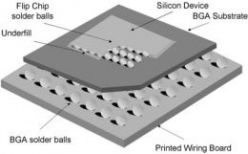
Today, BGA solder techniques are tried and tested and have been proved and trusted to be very reliable. It has also been found that once the process is set up correctly, BGA solder reliability is much higher than that for quad flat packs (QFP) or any other SMD package.
Reflow soldering technique is used to solder BGA because it helps the whole assembly to be brought up to a fixed temperature in order to melt the solder or solder balls underneath the BGA components.
For any BGA soldering, the solder balls on the package have a controlled amount of solder. Solder balls in various sizes of 18 mil, 24 mil, 30 mil, etc. are available. When the board with the solder balls and BGA package is placed in the reflow oven, it gets heated and the solder melts. Surface tension causes the molten solder to hold the package in the correct alignment with the circuit board. It is important to take care of the composition of the solder alloy and the soldering temperature so that the solder does not completely melt but stays semi-solid, so that the solder balls stay separate from each other and do not result in any bridging.
For manual SMD soldering and BGA rework, the following tools are typically required:
| Tool | Purpose | Key Features |
|---|---|---|
| Temperature-controlled soldering station | Provides stable heat for hand-soldering small parts | Fine tip (0.5–1.0 mm), adjustable 300–380°C |
| Hot air rework station / reflow oven | For multi-pin or leadless packages, or full board reflow | Temperature and airflow control, compatible nozzles |
| Fine gauge solder wire or solder paste | Enables clean joints on tiny pads | Wire diameter 0.3–0.5 mm or paste with stencil |
| Flux / flux pen | Helps solder flow, prevents oxidation | No-clean or water-soluble flux recommended |
| Precision tweezers & magnification | Handling and inspecting tiny parts | ESD-safe tweezers, magnifying lamp or microscope |
| Cleaning tools | Remove flux residue, inspect joints | Isopropyl alcohol, lint-free wipes, solder wick for rework |
The most widely used reflow soldering processes in electronics are:
Vapor Phase
Infrared (IR)
Because it offers higher yield and lower operation cost, convection-dominant IR soldering has evolved as the preferred process for reflow soldering. Vapor phase soldering continues to be used in niche applications. For some specialized jobs, other reflow soldering processes such as laser and hot bar resistance soldering are also used to complement vapor phase and IR processes. The process ultimately used should be selected on the basis of the specific requirements of the intended application, the solder defect results, and the overall cost.
| Challenge | Cause | Solution |
|---|---|---|
| Solder bridging | Too much solder or pins too close | Use minimal solder, apply flux, clean tip, wick excess |
| Tombstoning | Uneven heating or solder volume | Heat both pads evenly, use correct solder volume |
| Cold joints | Insufficient heat or dirty pads | Clean pads, ensure tip is heated, appropriate temperature |
| Pad lifting | Excessive heat or mechanical stress | Use appropriate heat/time, avoid dragging component, use proper board support |
| BGA, QFN | Hidden pins or too small for hand soldering | Use stencil plus reflow, hot air with proper profile, microscope |
BGA inspection is one of the toughest jobs. It becomes extremely difficult to inspect the BGA joints since the solder is underneath the BGA package and is not visible. The only satisfactory means of testing BGA solder joints is X-ray inspection. X-ray helps to see the joints underneath the package and thus helps in inspection.
Rework and hand soldering of BGA packages is the toughest part. It needs practice to do the job.
The most common practice to desolder BGA is hot air. Here are the steps to desolder a BGA package using hot air:
1. Apply liquid solder flux on the sides of the package
2. Preheat the package from both top and bottom. Heat can be given from the bottom using a preheater, while heat from the top can be given using a hot air rework system
3. Using the correct BGA nozzle, give heat on top of the BGA package
4. The solder balls underneath the BGA package will melt. Pick up the package with tweezers or using a vacuum pick-up tool
The most common practice to solder BGA is also hot air. Here are the steps to solder a BGA package using hot air:
Once the BGA package is removed, clean the pad and remove any excess solder from the board.
1. Apply flux paste (not liquid flux) onto the pad. Paste flux will help solder balls to stick so that they do not fall or change position
2. Place solder balls very carefully on the pad
3. Apply paste flux to the bottom (soldering side) of the BGA package
4. Carefully place the BGA package on the solder balls
5. Preheat and then apply hot air from both top and bottom
6. Solder balls will melt and get soldered
BGA technology and BGA soldering are very reliable if done using the correct procedure. A BGA has less resistance to heat and hence there is lesser or no damage due to overheating.
Capabilities
Payment Methods


Specials Price
Carriers


Support Hobbyist
Certificate


Customer Support
Follow Us