 Centre de connaissances
This Gold Phoenix PCB Knowledge Center article explores when to panelize PCBs, the benefits, separation methods, and advanced techniques.
The majority of board manufacturers create boards in large panels. These panels can include different designs or simply one design repeated many times. Depending on the end client’s requirements, manufacturers can cut the panels into individual boards. The board house can panelize the boards, or it can be done by the designer. Either way, if a design is going to be mass produced and assembled, panelizing boards is a good idea. While the basic principle is that of playing Tetris with the boards, there are several variables to consider when deciding whether or not to panelize and how best to implement it
One of the biggest potential benefits of panelizing boards is the cost savings. If a panelized design is provided, the costs some manufacturers charge for panelizing the boards are eliminated. It is possible to change the board design to better use the space on the panel, although this is likely to be very difficult due to other design constraints. Fortunately, there are also cost savings in the ease of dealing with a large panel of boards instead of each one individually.
When it comes to assembling boards in the thousands (up to hundreds of thousands), the process will be highly automated. Pick-and-place machines take time to switch between boards and to align the boards with their global fiducials. By reducing the frequency in which the pick-and-place machine needs to switch out boards, the assembly time is shortened, which is usually reflected in a lower assembly price. Populating the board is a sizable bottleneck in assembly, but panels may also reduce the setup and queuing time for the reflow process. When the boards are complete, test fixtures can be built to test entire panels at a time instead of individual boards, again saving time. Once the panels have been completely populated, soldered, and tested, they can be broken into individual pieces or shipped in panels.
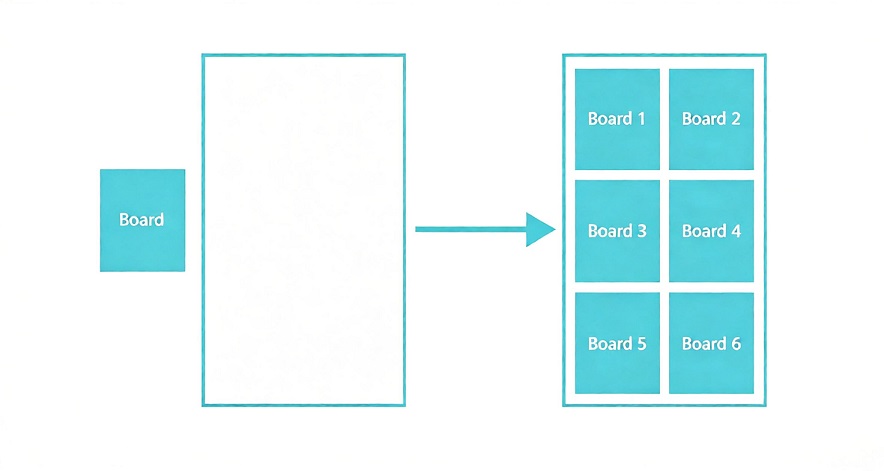
Panelizing is not for all situations, and sometimes when it is better to panelize, there are additional considerations. Shipping hundreds of small boards is relatively easy and inexpensive. Panels, on the other hand, are usually large enough to make shipping more challenging, and for panels where pallets are necessary, shipping options are even more limited. Assembly houses also have different capabilities, which determine how large a board they can handle with different pieces of equipment. Not only must the panels be able to fit into the pick-and-place machines, they must also be able to go through the reflow ovens. For conveyor-style reflow ovens, only the width is the limiting factor, but some commercial reflow ovens are batch-oriented, placing boards in, soldering them, and then pulling them out. Depending on the surface space, the assembly house may need to separate portions of the panels to fit them in the batch process. Finally, though testing many boards at the same time is more efficient, it also means a larger, more expensive, and more complex test fixture. In all of the processes, there may be concerns with warping, drift, and flexing of the panels. Despite these potential issues, the size of the panels typically does not pose problems and the inconveniences are usually worth the savings.
When manufacturers separate the boards from the panels, they usually do so by routing out the boards individually. If the entire panel is shipped, it is up to the end user to separate the boards. Unless there has been proper planning, this can be extremely difficult, requiring custom cutting or drilling that may look unprofessional. Fortunately, no reputable board manufacturer will send out panels of boards without working with the customer to ensure the individual boards can be broken out.
There are two different methods for breaking boards out of panels. These are chosen based on what is best for the individual design and its requirements.
Mouse Bites. Named because of the way the connection points look after the board is broken out of the panel, mouse bites are an excellent option when portions of the board need to have smooth, unbroken edges and other portions do not.
V-Scores. Instead of routing the outline of the board, a shallow V-shaped groove is made on the top and the bottom of the board, creating a weak edge that can be snapped out of the panel.

To determine the correct separation method, consider how the boards will be physically processed. For example, while it may seem straightforward to place the designs directly next to each other, there needs to be a small area set aside for the size of the routing tip. This is entirely dependent on the manufacturer, so either read through their literature or contact them to find out how much space must be given for the routing tip. V-scores as well can be different widths and angles, so work with the manufacturer to figure out what works best. If there are components that will hang over the edge of the board, those components also need sufficient space to be placed on the board without covering a portion of the adjacent board.
The more experienced one is in dealing with panels, the more creative the approach can be. For populating double-sided boards, panels can be made with boards of alternating sides so that the boards will go through the pick-and-place once, be soldered, flipped over, and run through the exact same program on the machine before being soldered once again. This method, while a bit tricky, reduces the overhead of needing to switch out programs on the pick-and-place machine for the different sides of the boards. The surface tension of the solder holds the components on the bottom side of the board in place while the other side is being reflowed. Board manufacturers and assembly houses both want the designs to be successful, so working with them on unique situations that need additional support is recommended.
Panelizing boards is a significant portion of the Design-for-Assembly process, and when done properly, can make a sizeable difference in the cost, the ease of assembly, and the success of the product. Over time, these techniques become second nature and simply another step in the design process for creating a high-quality, cost-effective product.
Capacités
Capacité PCB rigide
Capacité PCB flexible
Capacité d'assemblage PCB
Équipement PCB
Équipement d'assemblage PCB
Méthodes de paiement


Prix spéciaux
Transporteurs


Support pour amateurs
Certificat


Assistance clientèle
Suivez-nous


